Contributors:
Bruno Yempabou Lankoande, Researcher – The Institut Supérieur des Sciences de la Population (ISSP)
Tags:
Contributors:
Bruno Yempabou Lankoande, Researcher – The Institut Supérieur des Sciences de la Population (ISSP)
Tags:
Contributors:
Bruno Yempabou Lankoande, Researcher – The Institut Supérieur des Sciences de la Population (ISSP)
Tags:
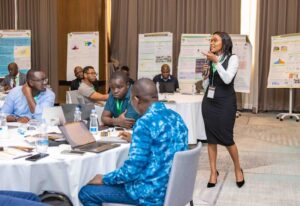
From April 2–4, 2026, researchers met in Ouagadougou, Burkina Faso, for a practical workshop focused on how non-conventional data can support health and demographic research. The workshop was organized by the Institut Supérieur des Sciences de la Population (ISSP) under the INSPIRE Project. It brought together about 20 researchers and assistant researchers from Health and Demographic Surveillance Systems in Ouagadougou, Nanoro, Kaya, and Nouna, as well as participants from Université Lédéa Bernard Ouédraogo.
The training responded to a persistent challenge across Sub-Saharan Africa that indicates limited availability of reliable and timely demographic data. Civil registration systems also remain incomplete in many settings, while large-scale surveys are expensive and not conducted frequently enough to meet ongoing data needs. At the same time, digital platforms are generating large volumes of data that can be useful for research if properly accessed and analyzed.
The workshop focused on how these digital data sources can complement conventional methods.
Understanding the Data Landscape
The first day focused on setting the context whereby participants explored the current state of demographic data systems in Sub-Saharan Africa and the limitations of relying solely on traditional sources. This was followed by an introduction to non-conventional data, including how social media and online platforms are being used in research. Participants were also introduced to basic tools required for working with digital data, including R programming, as well as HTML and CSS.
On the second day the workshop focused on hands-on learning as participants worked through web scraping exercises using R, with a case study on extracting data from online death notices. This helped demonstrate how publicly available online data can be collected and structured for analysis.
Sessions also introduced participants to APIs and how they can be used to automate data collection. Using the YouTube Data API, participants learned how to retrieve and organize data from online platforms.
Working with Social Media Data
The expert further scrutinized the potential of social media, particularly Facebook in providing useful data that can be used for health monitoring. Participants were trained on how to extract data using available APIs, including tools from Apify, and how to retrieve posts and comments for analysis. Examples of mortality-related data from Facebook were presented and discussed sparking conversations on how such data can be used in research, as well as the considerations that come with it.
Key Outcomes
By the end of the workshop, participants had:
- Practical skills in web scraping and API use
- Experience in extracting and structuring digital data
- A clearer understanding of how non-conventional data can support demographic and health analysis
Participants also discussed potential research ideas that could be developed further using these approaches. The INSPIRE Project shows real potential to improve how health and demographic data is produced and used across Sub-Saharan Africa. The Ouagadougou workshop demonstrated this in a practical way by equipping researchers with skills to collect and analyze data from online sources such as social media and digital platforms. This means that information on issues like mortality, disease trends, and community experiences can be accessed faster and at a lower cost, especially in areas where traditional systems are weak. In the long term, this can support earlier detection of health risks, better targeting of interventions, and more informed decisions by governments and practitioners, ultimately leading to improved services and outcomes for communities.